Food Security and Food Market Diversification: Reflections on an Important Topic
Дата: 10.08.2026
Anatoliy Tkachuk
I. The Current State of Ukraine’s Food Market
Over the past two years of war, Ukraine’s food market has shown a strong trend towardconcentration within the largest retail chains. Their market share has grown, while the shareof small sellers and markets has contracted.
While detailed causes require further analysis, these trends are partly linked to the war, disrupted logistics, economies of scale, and the automation of all processes—from productdelivery to the implementation of self-checkout counters.
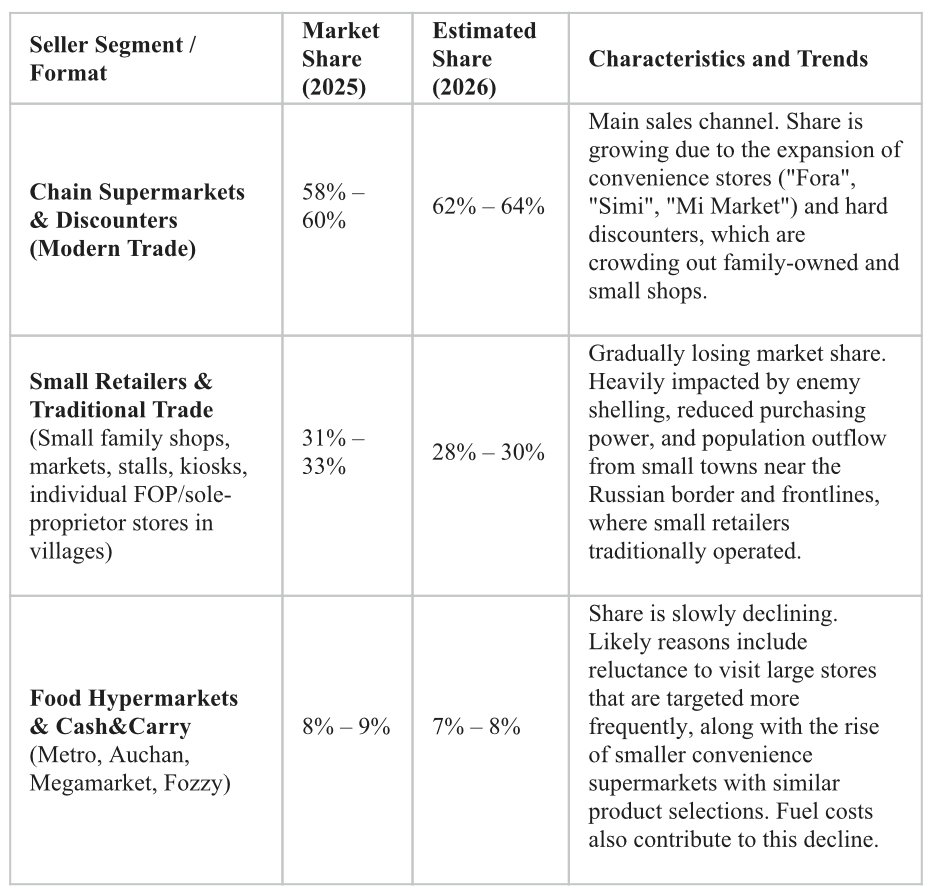
As shown above, large retailers and their smaller sub-brands currently account for nearly 70% of Ukraine’s food market.
II. Market Shares of Ukrainian Food Retailers (2025–2026)
While large retailers control 70% of the food market, the organized (chain) retail segment isdominated by the Top 10 FMCG operators, distributed by revenue and market share asfollows:
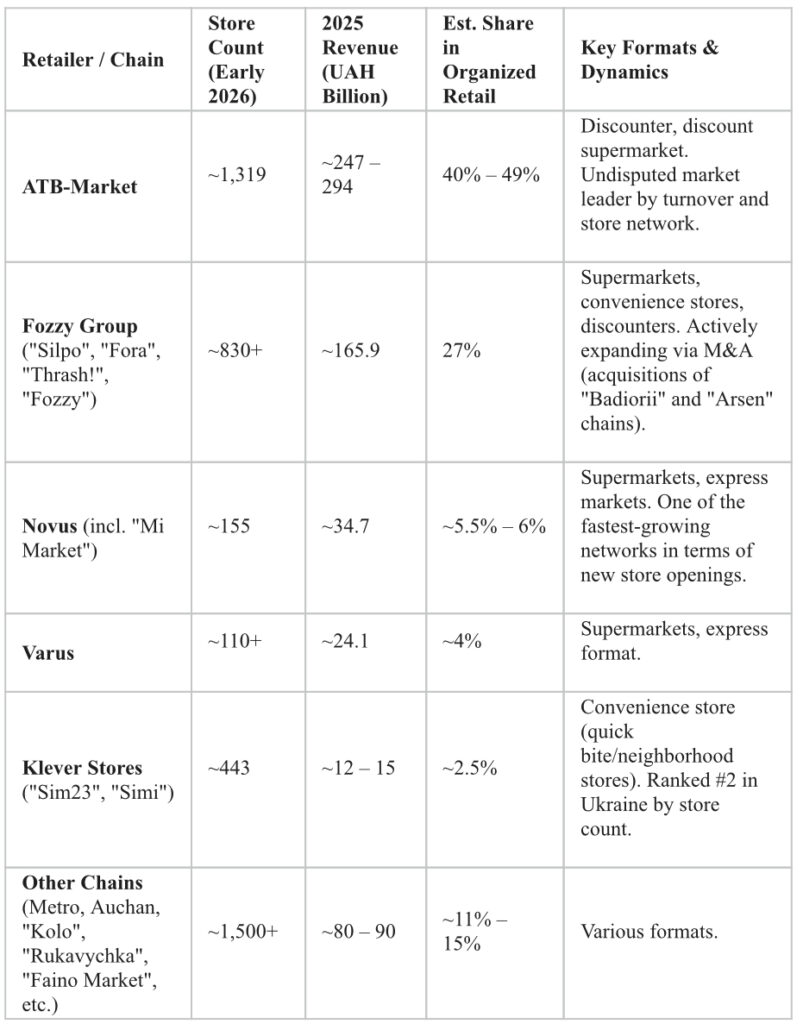
Together, ATB-Market, Fozzy Group, and Novus control over 80% of the organized foodretail market, representing over 56% of Ukraine’s total food market.
Such a high level of concentration during wartime poses significant vulnerabilities. To putthis into perspective, it is worth examining Russian strikes targeting food networks in 2026.
III. Strikes on Food Distribution Warehouses in 2026
Russia inflicted severe damage on warehouses, grain elevators, and poultry farms during thefirst year of the full-scale invasion in 2022. Throughout 2023–2024, the food market adaptedto wartime threats, leading once again to market concentration among major operators.
In 2026, Russia appears to be trying once more to deprive Ukrainians of access to basic fooditems by targeting major retail supply chains.
The table below summarizes the most destructive strikes on food distribution centers andmarkets in 2026:
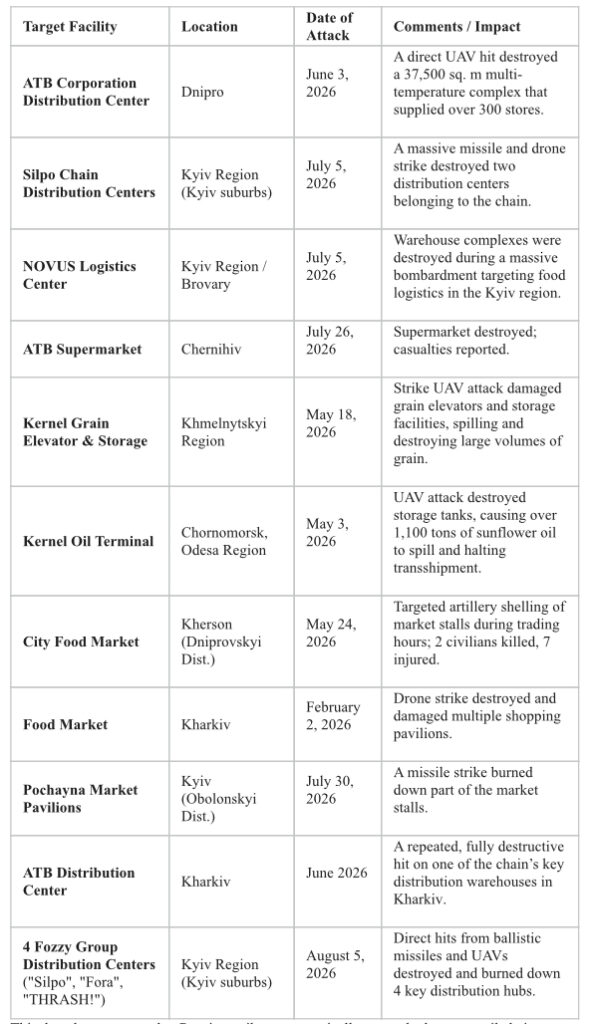
This data demonstrates that Russian strikes systematically target the largest retail chains, which supply food to the overwhelming majority of Ukrainians.
Key Takeaways and Considerations
This material has been prepared as part of the project Organisational and IT-supported models for growing local food markets for food security in the Baltic Sea Region and Ukraine.
The SFSC4FoodSec project is a transnational initiative led by the Swedish University of Agricultural Sciences (SLU) and funded by the Swedish Institute. The project is implemented in partnership with SLU (Sweden), IsoTech (Poland), the Civil Society Institute (Ukraine), the Latvian Rural Forum (Latvia) and Vytautas Magnus University (Lithuania).